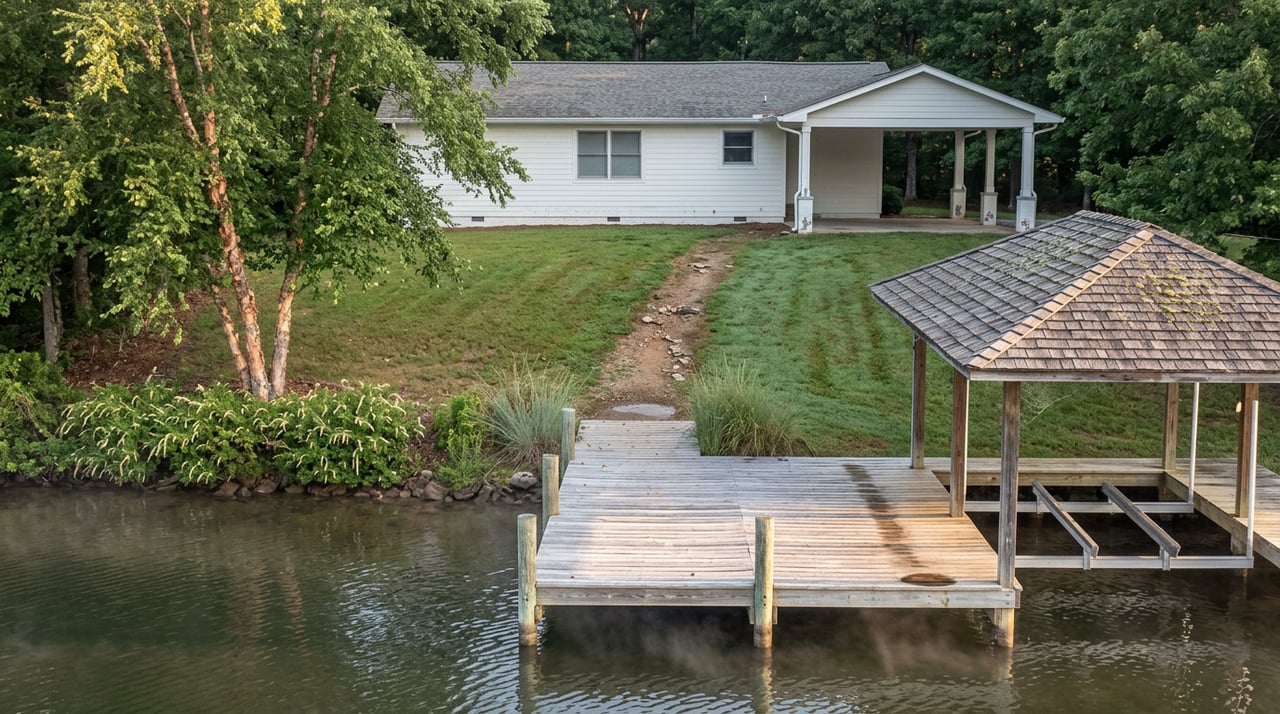
Most buyers assume that when they close on a waterfront home, everything attached to the property comes with it. The roof, the HVAC, the boat dock bobbing at the end of the yard. At Smith Mountain Lake, that assumption is wrong in one specific, expensive way, and it rarely surfaces until someone is standing at the closing table wondering why the dock they walked past on every showing isn't legally theirs yet.
Here's the mechanism nobody explains at the open house. Smith Mountain Lake was built in the 1960s as a hydroelectric reservoir, and Appalachian Power still holds the shoreline under a license from the Federal Energy Regulatory Commission. Everything below the lake's 800-foot elevation contour, which is essentially the entire shoreline, falls under Appalachian Power's authority rather than county zoning. That includes every dock, pier, boathouse and stretch of riprap on the lake. The dock isn't just a structure sitting on your new property. It's a structure sitting on land the power company controls, and your right to use it comes from a permit that Appalachian Power issues to a person, not to a parcel.
What "Occupancy and Use" Actually Means
The permit that governs most docks on the lake is called an Occupancy and Use Permit. According to Appalachian Power's own shoreline management guidance, permits issued after the Shoreline Management Plan took effect in August 2003, along with any permit that required prior FERC approval and every Non-Commercial Boat Dock, Pier or Landing permit, must be formally assigned to a new owner whenever the property sells. The sale of the house does not carry the permit with it. A separate application creates what is, in effect, a brand new permit in the buyer's name.
Appalachian Power's own guidance goes further, recommending that before any real estate transaction closes, the seller request a Status of Property report to confirm the dock is actually in compliance with the Shoreline Management Plan before anyone signs anything. That report is the closest thing this market has to a home inspection for the water side of the property, and it's optional in the sense that nobody makes you get one, right up until you discover a problem after you own it.
That's exactly the situation Appalachian Power spells out in its own FAQ: if a property sells without the proper assignment being filed, responsibility for compliance shifts to the buyer, who may be required to remove the structure or bring it up to current standards. The seller isn't necessarily off the hook either, but the buyer is the one left holding a dock they can't legally use until the paperwork catches up.
A Dispute That Shows What's at Stake
This isn't a hypothetical risk. A Franklin County couple, Bill and Lora Nissen, spent years in a standoff with Appalachian Power over a dock the company said was out of compliance. The case ended up in Franklin County Circuit Court, with Appalachian Power seeking a court order to remove the structure after the Nissens had exhausted their appeals, including one the Virginia Supreme Court declined to hear. The dispute only began moving toward resolution after the Nissens filed a new permit application days before a scheduled court date. Appalachian Power has removed noncompliant docks before, including one belonging to another lake couple after a similar multi-year fight.
None of that happened because someone forgot to mow their lawn. It happened because a structure below the 800-foot contour didn't match what the Shoreline Management Plan allows, and the gap between what exists and what's permitted became someone else's problem to solve, in court, over years.
If you're buying waterfront here, treat the dock the way you'd treat a well or a septic field on any other property: verify it before you're emotionally attached to closing.
A Deadline That Matters Right Now
Appalachian Power recently changed how long these permits last. One-year Occupancy and Use Permits are being extended to two-year terms, but the company has also announced that no requests to extend an existing one-year permit's expiration date will be accepted after December 31, 2026. Once a permit expires under the old or new terms, the holder has to file a completely new application rather than simply asking for more time.
For anyone selling a waterfront home this year, that cutoff is worth building into the timeline. If your dock's paperwork is due to lapse and you're planning to list before year end, an expired permit adds a step to an already multi-week process. For buyers, it means asking not just "is there a dock" but "when does this dock's permit expire, and under which set of rules."
The Septic Rule Living in the Same Blind Spot
The dock isn't the only piece of lake-adjacent infrastructure that comes with rules most buyers never think to ask about. Franklin County has required inspection or pump-out of any septic system within 500 feet of the Smith Mountain Lake shoreline every five years since the county's Mandatory Pump-Out Program took effect in July 2006. It exists because a failing septic system doesn't just cost the homeowner money to fix. It's a direct water quality risk to a lake that a lot of people are also swimming, fishing and drawing drinking water near.
A septic system that's overdue for its five-year inspection won't necessarily kill a deal, but it's the kind of detail that surfaces late in due diligence if nobody asks early. Pairing a septic pump-out request with a dock Status of Property request turns two separate blind spots into one clean pre-offer checklist.
Before You Write the Offer or Sign the Listing Agreement
| If you're buying | If you're selling |
|---|---|
| Ask for the dock's permit number and current expiration date before writing an offer | Request a Status of Property report from Appalachian Power before listing |
| Confirm in writing that the seller will file the assignment application at or before closing | Check whether your septic system falls within 500 feet of the shoreline and is due for its five-year pump-out |
| Budget for a licensed survey, typically several hundred dollars, if the dock's documentation is incomplete | If your permit is a one-year term expiring soon, decide whether to renew before December 31, 2026 or file fresh under the new two-year terms |
| Ask whether the dock predates 2003 and is grandfathered, since older docks lose that protected status once significantly modified | Disclose any known modifications made to the dock since it was originally permitted |
What This Means for Timing Right Now
The most recent lake-wide numbers I have cover January through April 2026: 76 waterfront homes were active with an average list price around $1.6 million, 26 were pending, and 39 had closed at an average sale price near $1.16 million. Homes were selling at about 97 percent of list price after an average of 73 days on market.
That 73-day window matters here in a way it wouldn't in a faster market. A dock permit assignment or a septic inspection can each take weeks to schedule and complete. In a market where homes are sitting for over two months before closing anyway, there's genuinely time to get the Status of Property report back, confirm the septic pump-out is current, and fold any needed dock work into the existing timeline instead of racing it after the fact. Buyers aren't losing the house to a faster offer if they take ten extra days to confirm the dock is clean. Sellers who get ahead of these two checks before listing are removing the single most common reason a lake closing gets delayed at the last minute.
A Few Questions Worth Asking Before You Get Attached to a Listing
Does every waterfront home at Smith Mountain Lake have a dock permit on file? Most do, but permits issued before 2003 predate the current Shoreline Management Plan and were grandfathered in. Those older docks can lose that protected status if they're modified without a new permit, which is worth confirming before you assume an older dock is automatically fine.
If the dock looks fine, do I still need to worry about this? Visual condition and permit compliance are two different things. A dock can look perfectly sound and still be out of compliance with setback rules, size limits, or structures like enclosed rooms that were expanded without authorization.
Who do I actually contact to check? Appalachian Power's Shoreline Management staff handles the Status of Property report and permit assignment process directly. Your agent or closing attorney should be looped in early enough that the request isn't a last-minute scramble.
Buying or selling on Smith Mountain Lake means dealing with two governments at once, the county for the house and Appalachian Power for everything below the waterline. Getting that second one right before you're under contract is the difference between a clean closing and a dock dispute nobody planned for. If you're weighing a purchase or a listing here and want someone who checks both boxes before they matter, reach out to Alexandra Taylor for a free consultation or start with an instant home valuation to see where your property stands today.